
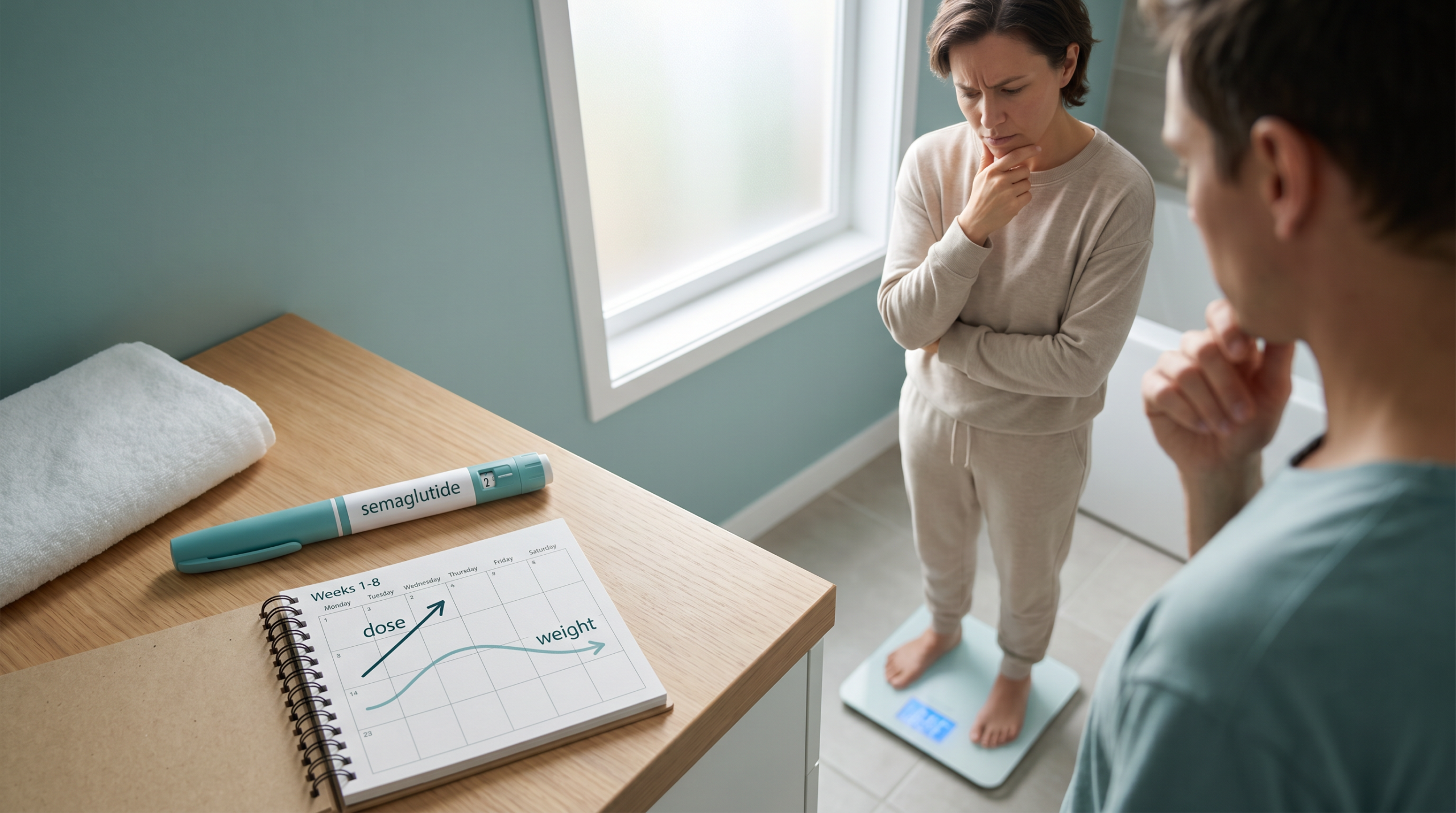
Semaglutide can seem a “slow burn” particularly during weeks 1-6/8 because most patients are still on dose escalation (gradually increasing dose to minimise side effects). For Wegovy (semaglutide 2.4 mg), the recommended dose is 0.25 mg weekly for weeks 1-4, 0.5 mg for 5-8 weks and from there you continue to escalate every 4 weeks until you hit plateau at around week 17+.
This is important because early doses are mainly for tolerability and significant and consistent fat loss will often happen later in the dose escalation process once appetite suppression is consistent week-on-week.
Biologically and per Mayo Clinic Diet, early weight loss is usually limited and dramatic outcomes are achieved over months not weeks.
Here’s a realistic with references framework for 3 weeks, 4 weeks, 6 weeks and 8 weeks (2 months) and tables showing example weight loss ranges for your starting weights.
The “Slow Burn” Reality
If you are only a few weeks in and haven’t lost weight then you’re not necessarily a “non-responder”.
Here’s why the first few weeks are typically disappointing:
- The dose is ramped up gradually. The first 8 weeks are usually 0.25 mg → 0.5 mg. That’s not the “full blast dose” for sustained weight loss.
- Early weight loss varies a lot. Real-world data (not a controlled trial) for average weight loss at 3 months on semaglutide was 3.6% (and ~5.8% at 6 months). This would suggest that many will be in the low single digits at 8 weeks (particularly if still on the titration phase, or not on high doses).
- Trials report greater losses – but later. In the STEP 4 trial, people who completed the first 20 weeks of semaglutide (titrated to 2.4 mg) lost ~10.6% on average, again showing that initial 2 months may not be predictive of the longer term.
So the bottom line is that early stutters are typical; what’s more important is to make sure the process is going smoothly (dose, adherence, appetite change, calories/protein, activity, sleep, etc.)
1) The 3-Week Mark: The Adjustment Phase
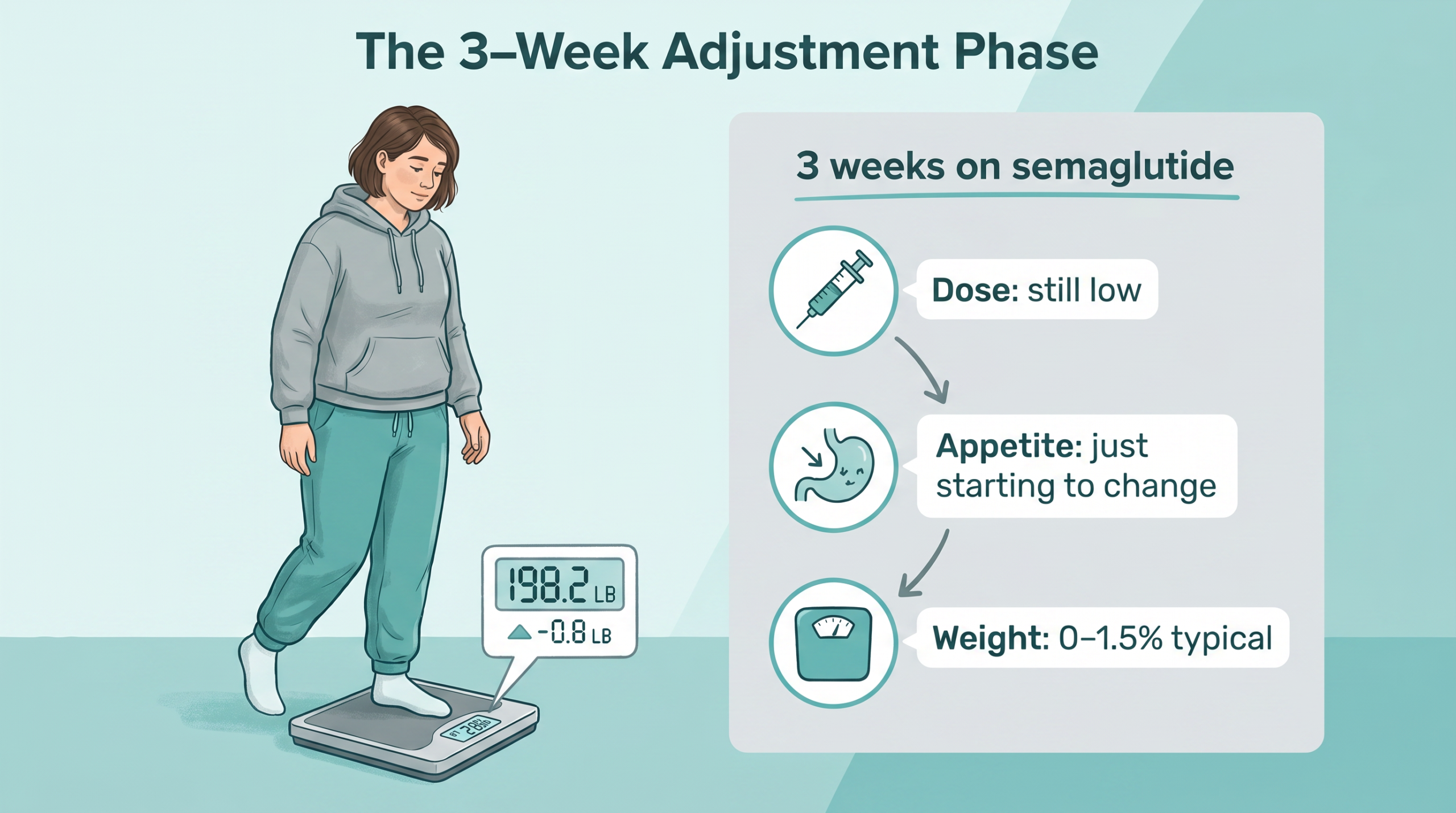
After three weeks, most patients are still in the initial period of treatment. The dose is low, the appetite suppressant is mild and the body is still getting used to the delayed emptying of the stomach and changes in hunger.
Large randomized studies like the STEP program were not designed to measure early-week weight loss because it’s very variable and unreliable, as outlined in the STEP trial methodology in the New England Journal of Medicine.
What’s going on at 3 weeks
- Slowing of gastric emptying may result in early satiety or bloating
- Central appetite mechanisms start to change, but not always
- Scale weight may be temporarily increased by nausea or constipation
- Weight loss, if it occurs, is minimal and could be concealed by water retention
Semaglutide’s FDA clinical pharmacology report notes that the initial dose is given to test tolerability and prime the receptor, but not for weight loss
Clinically, it’s natural for there to be no weight loss at three weeks.
Expected weight change at 3 weeks
Using conservative scaling from later, validated timepoints in clinical trials, and pharmacokinetic modeling, the average early loss would be:
0% to ~1.5% of the original weigh
Most will be closer to the lower end.
Sample expected weight loss at 3 weeks (Men & Women)
| Person | Starting Weight | Typical 3-Week Loss (Scale) | Primary Patient Experience |
| Man | 180 lb | 0–2.7 lb | Mild appetite reduction, early nausea or constipation, scale may fluctuate daily |
| Man | 220 lb | 0–3.3 lb | Feeling “less hungry sometimes” but still able to eat normal portions |
| Man | 250 lb | 0–3.8 lb | Reduced snacking, inconsistent satiety, weight loss not obvious yet |
| Man | 280 lb | 0–4.2 lb | Appetite noise slightly quieter, scale often unchanged due to water retention |
| Woman | 150 lb | 0–2.2 lb | Bloating or constipation may mask fat loss; hunger still present |
| Woman | 170 lb | 0–2.5 lb | Eating a bit less without trying; scale may stall |
| Woman | 190 lb | 0–2.9 lb | Early fullness, slower digestion, little visible weight change |
| Woman | 210 lb | 0–3.1 lb | Appetite variability day-to-day; loss not yet consistent |
Why this might be like “no weight loss”:
As we see in the above stages, appetite suppression and diminished cravings may occur before any significant fat loss is seen on the scale. The daily weight fluctuations of 2-5 pounds from changes in body water, glycogen, salt, constipation and menstrual cycles can easily mask the modest losses seen at low doses.
At this point, the purpose of the medication is to establish a tolerance and control the appetite not to lose weight which is why the patient’s experience in the table above often improves before her weight.
2) The 4-Week Mark: First Dosing “Month” Complete
At week four, patients have finished the starter dose. Appetite signals are louder, but this doesn’t always translate into changes in behavior. By now, patients are starting to eat slightly less than normal but not enough to lead to consistent fat loss.
The FDA’s summary of clinical pharmacology data shows semaglutide’s weight loss is dose dependent with greater reductions in weight as patients approach and surpass the 1.0 mg weekly dose.
What happens at ~4 weeks
- Hunger reduction may be more clear, but not necessarily striking
- Side effects may be resolving (or not resolved)
- Patterns of eating may be changing but may not be consistent yet
Realistic 4-week goal: ~0.5% to ~2.5% of initial body weight.
Sample expected weight loss at 4 weeks (Men & Women)
| Person | Starting Weight | Typical 4-Week Loss (Scale) | Primary Patient Experience |
| Man | 180 lb | 1–4.5 lb | Eating less without effort |
| Man | 220 lb | 1–5.5 lb | Fewer cravings; weekend overeating |
| Man | 250 lb | 1–6.2 lb | Appetite improved, scale slow |
| Man | 280 lb | 1–7.0 lb | Portions shrinking gradually |
| Woman | 150 lb | 0.8–3.8 lb | Constipation common |
| Woman | 170 lb | 0.8–4.2 lb | Early fullness noticeable |
| Woman | 190 lb | 1–4.8 lb | Hormonal fluctuations affect scale |
| Woman | 210 lb | 1–5.2 lb | Clothes slightly looser |
Critical Note: These values are averages. Genetics, starting metabolic rate, food quality and physical activity levels vary. MD Pilot says if you don’t lose this much, it doesn’t mean the drug isn’t working. It could just mean your response curve is different and the impact will be greater with higher doses.
Being at 0% at 4 weeks may still be normal if your appetite is not yet suppressed and/or you are constipated or retaining water.
3) The 6 Week Mark: The Transition Phase
At week 6 many individuals are taking 0.5 mg (weeks 5-8 in the Wegovy dose escalation). Pharmacodynamic studies demonstrate that GLP-1 receptor activity increases non-linearly, which means that improvements often come on quickly.
The American Diabetes Association reports that even small weight loss (5-7%) with GLP-1 receptor agonists is linked to significant changes in insulin sensitivity, blood pressure and blood lipids.
What’s typical at ~6 weeks
At this point, people can notice:
- “Food noise” decreases
- The urge to eat due to emotional causes becomes easier to stop
- Portion control feels more natural
- You start to lose weight more regularly
But stalls happen if:
- energy intake doesn’t change (fluids are a major source)
- protein is low (hunger rebounds)
- weekends undo weekdays
- constipation/poor sleep inflates scale weight
Realistic goal for 6 weeks: ~1.0% to ~3.5% of initial weight
Sample expected weight loss at 6 weeks (Men & Women)
| Person | Starting Weight | Typical 6-Week Loss (Scale) | Primary Patient Experience |
| Man | 180 lb | 2–6 lb | Clear appetite suppression |
| Man | 220 lb | 2–7.7 lb | Fewer urges to snack |
| Man | 250 lb | 2.5–8.8 lb | Consistent intake reduction |
| Man | 280 lb | 2.8–9.8 lb | Weight trending downward |
| Woman | 150 lb | 1.5–5.3 lb | Pants looser; scale uneven |
| Woman | 170 lb | 1.7–6.0 lb | Less emotional eating |
| Woman | 190 lb | 1.9–6.7 lb | Hunger easier to manage |
| Woman | 210 lb | 2.1–7.4 lb | Energy stabilizing |
4) The 2-Month Mark (8 Weeks): The Therapeutic Threshold
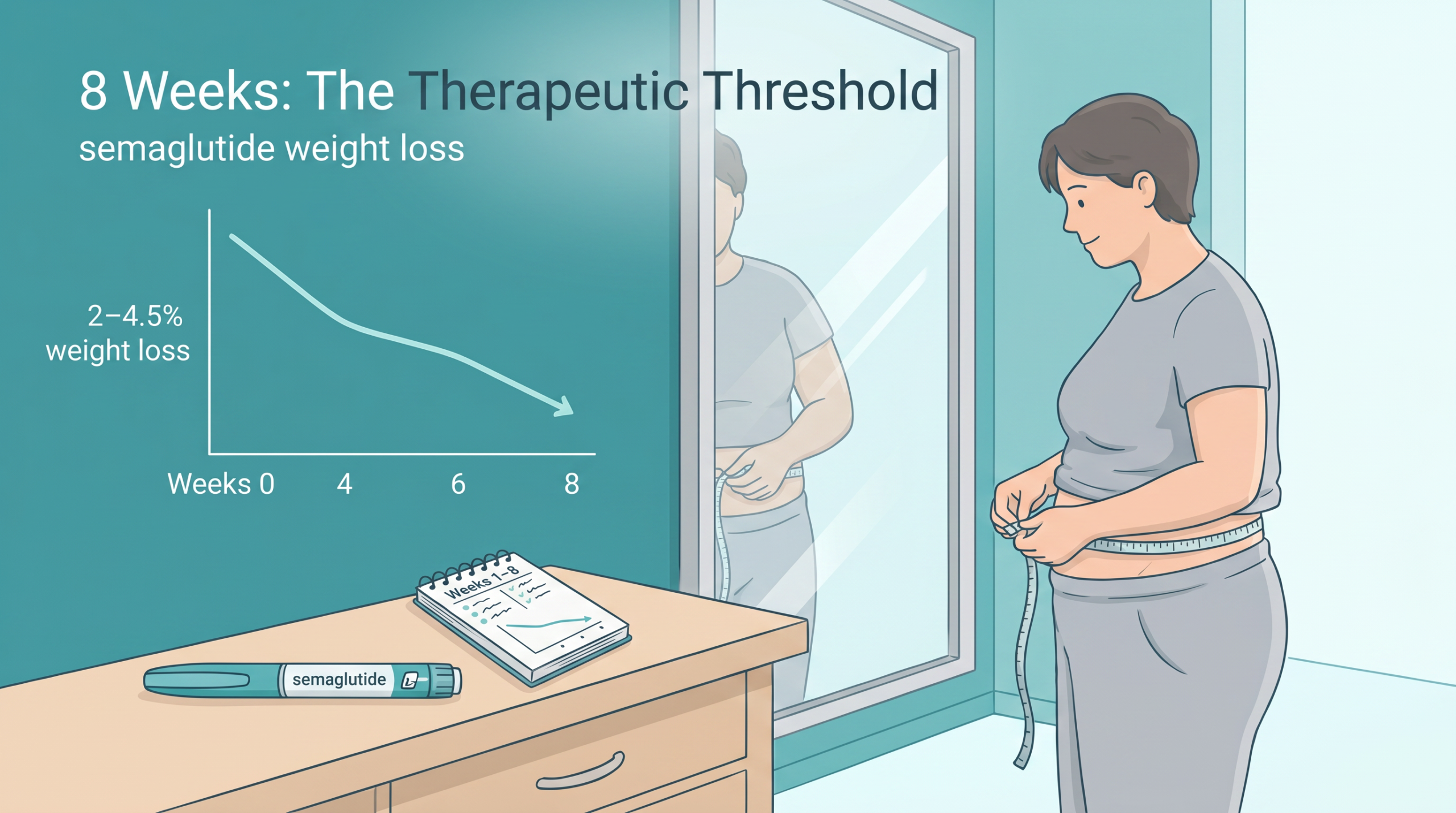
By week 8, people are still titrating, but we’re getting near the dose where fat loss occurs more reliably.
In observational studies, average losses of 3-4% are reported at 8-12 weeks but there is considerable variation.
What you can expect by ~8 weeks
- This is the first time where many say:
- “I can finally feel it’s working,” or
- “I feel it, but it’s slow to go down on the scale.”
Referenced reality check:
Real-world real-life results, where the average semaglutide weight loss is ~3.6% at 3 months, suggests many people at 8 weeks might be in the range of ~2-4% (but with many individual variations).
Realistic 8-week goal: ~2.0% to ~4.5% of initial body weight.
Sample expected weight loss at 8 weeks (Men & Women)
| Person | Starting Weight | Typical 8-Week Loss (Scale) | Primary Patient Experience |
| Man | 180 lb | 4–8 lb | Appetite reliably reduced |
| Man | 220 lb | 4–10 lb | Clear downward trend |
| Man | 250 lb | 5–11 lb | Eating habits transformed |
| Man | 280 lb | 6–13 lb | Cravings markedly quieter |
| Woman | 150 lb | 3–7 lb | Consistent fat loss begins |
| Woman | 170 lb | 3–8 lb | Less emotional eating |
| Woman | 190 lb | 4–9 lb | Visible body composition change |
| Woman | 210 lb | 4–9 lb | Plateau risk decreasing |
At 8 weeks, patients report a sense of “reality”. Although the big drops usually happen from 3-6 months, what happens in the first 8 weeks is crucial.
Why You Might Be Stalled (The Checklist)
If you’re doing the right things to lose weight but it’s not happening, then it’s probably:
A) You’re on a low dose (most common)
A lot of people don’t lose regularly until later steps. Standard titration is slow.
Self-test: Have you changed your appetite? If not, you may not have found your “sweet spot” yet.
B) You didn’t reduce your calories as much as you thought
Semaglutide is a great tool but it doesn’t defy physics. It helps you eat fewer calories because it takes away hunger but it doesn’t make them disappear.
Common stealth calories:
- coffee and tea with added sugar, juices, smoothies
- “healthy” snacks (nuts, granola, protein bars)
- restaurant servings (even with smaller appetite)
Do you keep an honest food diary (even an approximate)? We can end up eating more than we think and calorie-dense foods (nuts, oils, cheeses) can still add to the food surplus with less hunger.
C) Protein is too low (hunger rebounds)
Low protein can lead to:
- more grazing
- weaker satiety
- risk of losing muscle (which can slow down your metabolism)
D) You’re dehydrated and constipated
Semaglutide slows down the rate of food movement through the stomach and intestines (some experience constipation). This can mask several pounds of weight loss.
At the same time, stressors (cortisol), menstrual cycles, salt intake and even variations in carbohydrate intake (glycogen stores) can lead to fluid retention that causes your body weight to plateau (1-3 weeks) while you continue to lose fat.
For a more comprehensive discussion of how weight loss triggers adaptive metabolic changes such as changes in leptin and energy metabolism, see this clinical review article in the American Journal of Clinical Nutrition, “Metabolic adaptation to weight loss: implications for the athlete,” which describes these “defense” mechanisms against weight loss.
E) Weekend/weekday mismatch
You can be in deficit Monday to Friday and reverse it with:
- restaurant meals
- alcohol
- snacks while socializing
F) You’re not taking enough doses or aren’t consistent (real world issue)
In practice, many patients don’t remain on treatment, or don’t reach/have higher doses, which has a significant impact on outcomes.
G) Other medical factors
- hypothyroidism not well controlled
- insulin/sulfonylureas and other weight promoting medication
- sleep apnea / poor sleep
- PCOS-related insulin resistance
- high stress + high cortisol activities (snacking, cravings)
When to Talk to Your Doctor
You should talk to your doctor sooner (not later) if:
- You have severe side effects (nausea and vomiting that won’t stop, dehydration, severe abdominal pain, signs of gallbladder problems, etc.). The Wegovy label provides serious warnings you should check with your doctor.
- You have no change in appetite after several dose escalations (may be dose/titration plan, technique, storage or quality of medication depending on what you’re taking).
- You have no weight change by ~8-12 weeks, AND no change in intake or activity (this may mean you need specific nutrition goals, better titration or a new strategy).
- You are on a therapeutic dose for a sufficient time. Early response is a commonly used criteria in obesity pharmacotherapy guidelines: if you haven’t lost about 5% of your body weight after 3 months of an effective dose, it’s time for a plan change.
(Note: that 3 months is more likely to be the duration of being on an effective dose with compliance, not the 3 months after the initial starter dose.)
Conclusion
If you have not lost weight at 3-8 weeks, it may still be OK if you are early in the titration process. Semaglutide is best used as a cumulative effect: sustained appetite loss → sustained energy deficit → cumulative weight loss over weeks of months, not days.
Early checkpoints are good, if used right:
- 3 weeks: are you tolerating it and getting adjusted, with appetite change?
- 4 weeks: are you starting to change your intake (even if the scale is bouncy)?
- 6 weeks: are you feeling more satisfied, less hungry?
- 8 weeks: are you getting progress to the ~2-4.5% range or is there a barrier?
If you’re not making headway, don’t give up; do the checklist, tighten the controllable factors and speak to your clinician early enough to make changes to dose, side-effect interventions, nutrition goals or other aspects of the plan.
References:
- https://www.accessdata.fda.gov/drugsatfda_docs/label/2025/215256s024lbl.pdf
- https://diet.mayoclinic.org/us/blog/2024/how-long-do-you-spend-on-semaglutide-for-weight-loss/?
- https://jamanetwork.com/journals/jamainternalmedicine/fullarticle/2821080
- https://jamanetwork.com/journals/jama/fullarticle/2777886
- https://www.nejm.org/doi/full/10.1056/NEJMoa2032183
- https://www.fda.gov/media/108194/download
- https://www.fda.gov/drugs
- https://md-pilot.com/when-does-semaglutide-start-working-for-weight-loss/?
- https://www.wegovy.com/taking-wegovy/dosing-schedule.html
- https://diabetesjournals.org/care/article/45/Supplement_1/S125/138908/9-Pharmacologic-Approaches-to-Glycemic-Treatment
- https://trytrimi.com/blog/semaglutide-results-timeline
- https://dom-pubs.onlinelibrary.wiley.com/doi/10.1111/dom.14863
- https://www.tandfonline.com/doi/full/10.1186/1550-2783-11-7
- https://www.novo-pi.com/wegovy.pdf
- https://www.endocrine.org/clinical-practice-guidelines/pharmacological-management-of-obesity


GLP-1 Delivered
- Lose pounds of fat every week
- Weight Loss Money Back Guarantee
- No membership or hidden fees! Everything you need is included
- Start for just $179, no insurance required + free shipping


TRIMRX - GLP-1 DELIVERED
- 100% online medical review with licensed U.S. providers
- No insurance required
- Transparent pricing
- No hidden fee
Read this Next

Qsymia vs Wegovy
If you are interested in losing weight then there are different types of drugs that you can try. The...

Rybelsus (Oral Semaglutide) for Weight Loss: Things to Know
Since the 1940s there has been a search for a ‘magic pill’ for weight loss by academics and the...

Review of Berberine for Weight Loss
Berberine is one of the naturally occurring alkaloids found in some of the plants. It also has several positive...

Peptides for Weight Loss: Things to Know
Peptides are amongst the products from amino acids that build proteins in the body. Therapeutic peptides are developed to...