
Expectations are high when starting a GLP-1 medication such as semaglutide or tirzepatide, and for good reason. News reports and the results of clinical trials tout double-digit weight loss, dramatic suppression of hunger and sustained metabolic benefits. So when the weight doesn’t drop or even stops increasing, it’s natural to be bewildered, or disheartened, or even think the drug has stopped working.
But there’s an important fact that most people don’t hear from the beginning: weight loss may not happen right away, but that doesn’t mean the GLP-1 treatment isn’t working. In fact, the most common initial response to GLP-1s (particularly in the first few weeks to few months) is weight levelling-off. If you were steadily gaining weight prior to GLP-1 treatment, just not gaining any more weight can be the first sign your medication is working as expected.
Here are 7 science-based reasons why people may not see much improvement, and how to know if your weight loss is “normal” or not.
I Stopped Gaining Weight on GLP-1. Is My Weight Loss Normal? Expected Weight Loss on Semaglutide and Tirzepatide.
First: Stabilizing Weight Is a Good Thing
If you were gaining weight before you began a GLP-1 medication, then halting weight gain is not a loss, it’s a win. For many people particularly those with insulin resistance, metabolic syndrome or a long history of steady weight gain, simply stopping weight gain indicates that the drug is already changing hunger and metabolic signals.
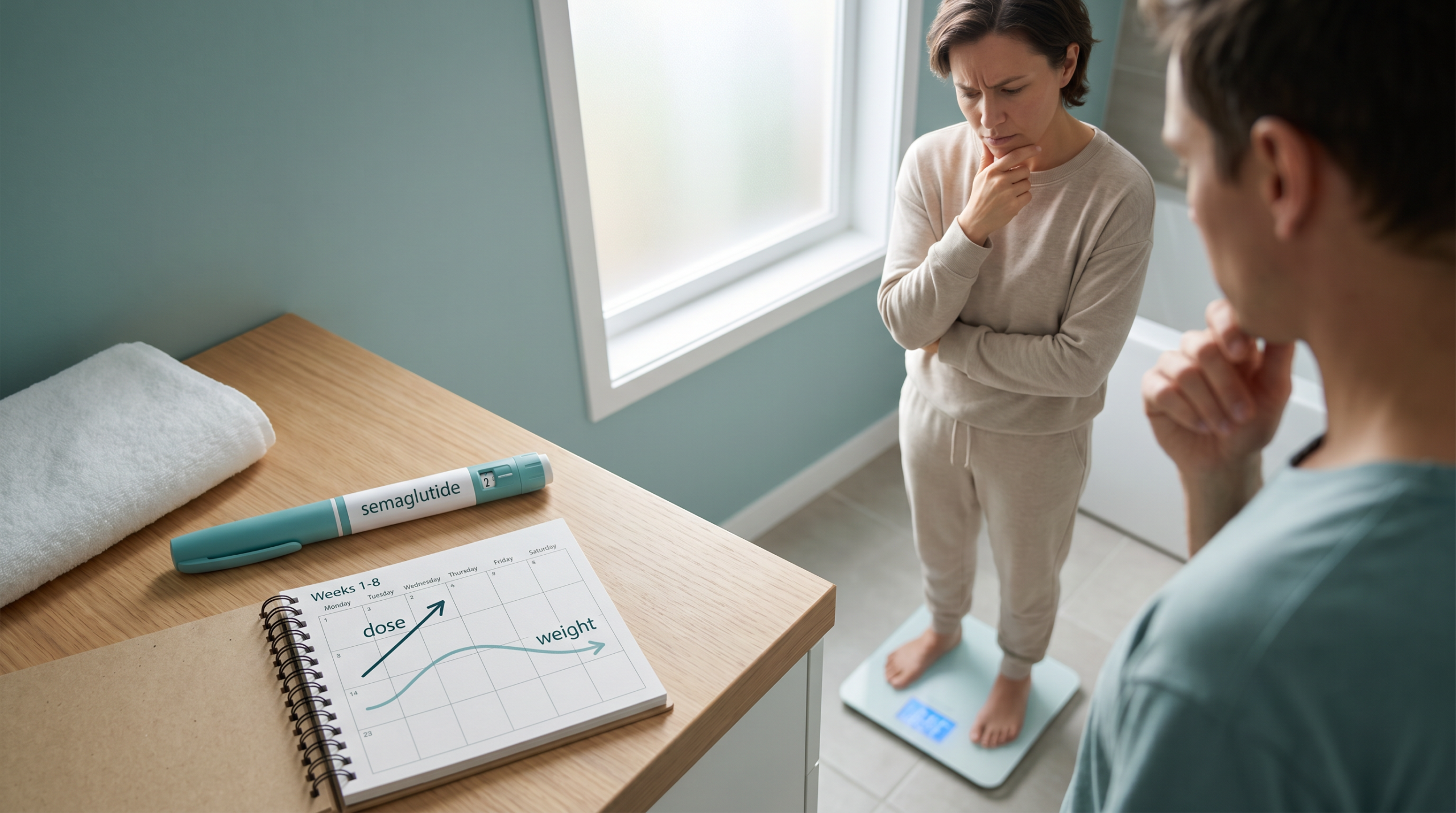
This is especially true in the first 4-8 weeks of the titration period. Starting with a low dose helps avoid side effects and adjust to the medication. At this point, GLP-1s may suppress hunger and overeating, but may not yet cause a large enough energy deficit to result in substantial weight loss.
How Much Weight You Can Lose on Semaglutide (Wegovy / Ozempic)
In the STEP 1 clinical trial adults with overweight or obesity (but not diabetes) who used semaglutide 2.4 mg per week in combination with lifestyle interventions reduced their weight by ~14.9% at 68 weeks. Crucially this weight loss was sustained and occurred after the dose escalation (not during the initial starter doses).
How Much Weight You Should Lose on Tirzepatide (Zepbound / Mounjaro)
The SURMOUNT-1 trial showed dose-related weight loss with an average of ~20.9% weight loss after 72 weeks on the 15 mg dose. Slightly lower doses led to less weight loss, but still significant, and highlight the importance of time and dose in assessing response.
Why These Numbers Need Context
These are the average results of the group on the trial. Real world results depend on:
- How long you’ve been on treatment
- Whether you’ve achieved a maintenance dose
- Protein intake and resistance training
- Sleep quality and stress levels
- Side effects that limit intake or activity
- Insufficiency or diabetes
If your weight has stopped going up but isn’t going down yet, you may be on track, particularly early on. But the trick is to assess progress over months not weeks and taking into account the dose, lifestyle and trends rather than day-to-day fluctuations.
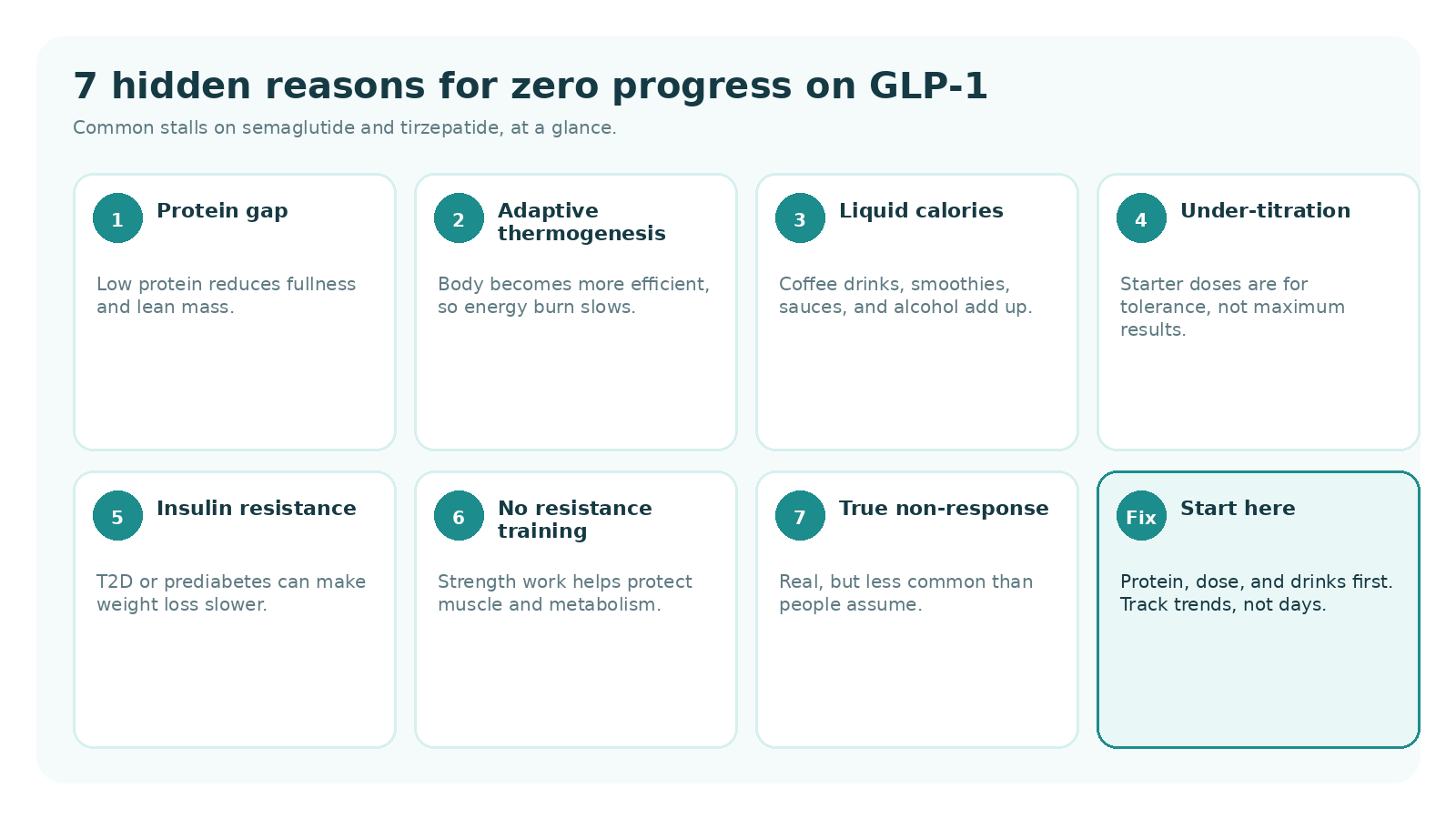
7 Reasons for “No Progress” on GLP-1
1) The “Protein Gap” and Muscle Loss
What happens: GLP-1s suppress appetite so total food intake will usually decrease but protein will decrease disproportionate to fat and carbs. If you don’t eat enough protein (and don’t engage in much weightlifting), you may lose more muscle than you anticipate during weight loss.
Why it may appear as “no progress”:
- You will have a lower energy requirement.
- Weight change may slow as body composition changes.
- You might lose inches more slowly than you’d like.
A 2024 review of lean mass changes with GLP-1 therapies states that lean mass loss can be quite significant in some studies and the need for strategies to prevent muscle loss during pharmacologic weight loss.
A body-composition analysis of the STEP 1 trial also found significant changes in fat and lean mass with semaglutide weight loss.
What to do (high impact):
- Protein-first meals: 25-35g per meal, 2-4 times a day.
- Supplement with a protein bridge if not hungry (Greek Yogurt, protein shake).
- Pair with resistance training.
2) Adaptive Thermogenesis (The “Famine” Response)
What happens: With weight loss (or even reduced intake), your body adapts to be more efficient, with a lower than expected energy expenditure. This is sometimes referred to as adaptive thermogenesis.
A seminal review explains that adaptive thermogenesis can block weight loss and increase the risk of plateauing/re-gaining weight.
And a systematic review assessed whether adaptive thermogenesis takes place after weight loss and if it influences energy expenditure.
Why it can appear to be “the drug isn’t working”:
- You have a bigger-than-anticipated reduction in energy requirements.
- You start fidgeting less (lower NEAT: fidgeting, walking, etc).
- You may feel hungrier, making it harder to stick to it.
What to do:
- Don’t “eat less”. Rather, control consistency + quality (protein).
- Increase steps gradually (+1,500 to +3,000/day).
- Include resistance training to maintain lean mass.
3) Hidden “Liquid Calories” and Habit Drifting
What happens: Liquid calories are convenient and are not as well compensated for at subsequent meals.
In a landmark controlled feeding study, liquid carbohydrate resulted in positive energy balance versus solid carbohydrate (people didn’t compensate).
Meanwhile, a research modelling plateaus in weight loss found even minimal compliance problems can generate the plateau effect.
Common culprits:
- Coffee beverages, juice, soda
- Creamers, “healthy” smoothies, meal replacements (used on top of food)
- Alcohol (often overlooked)
- Eating out often (oils, sauces, energy density)
What to do (7-day fix):
- Evaluate drinks and extras (milk, oils, sauces).
- Mostly zero calorie beverages.
- If you drink a shake: use as a substitute
4) Under-Titration (The Dosage Sweet Spot)
What happens: Many assess early while still on low (tolerability) doses.
Semaglutide (Wegovy) dosing: Wegovy begins at 0.25 mg per week and escalates every 4 weeks to a dose of 1.7 mg or 2.4 mg weekly based on tolerability and effectiveness.
Tirzepatide (Zepbound) dosing: Zepbound starts at 2.5 mg per week for 4 weeks and the label specifically states 2.5 mg is for start of treatment and not recommended as a maintenance dose.
Why it can appear “no response”:
- Eating less might be subtle at lower doses.
- Early weight plateau is common (particularly if you were gaining).
What to do:
- If you’re still titrating, look for trends over 4-8 weeks not weekly fluctuations.
- If you’re plateaued for 6-8+ weeks at a stable dose, talk with your prescriber.
5) The “Incretin Effect” and Insulin Resistance
What it means: Incretins (GLP-1 and GIP) enhance insulin release after a meal; the “incretin effect”.
But in type 2 diabetes and severe insulin resistance, there are often changes in hormone responses and metabolic adaptability, typically resulting in lower average weight loss compared to participants without diabetes.
For instance, in STEP 2 (type 2 diabetes), average weight loss with semaglutide 2.4 mg was less than STEP 1 (no diabetes), as often occurs in obesity.
In SURPASS-2 (type 2 diabetes), tirzepatide showed consistent weight loss and glucose lowering and this is a good result in insulin-resistant populations but there are still individual differences in weight loss and dose variation.
The takeaway for “no progress”:
- If you have significant insulin resistance (often indicated by T2D, prediabetes, NAFLD, etc), you may lose weight more slowly.
- You may need longer, full-dose and more lifestyle “support beams” (protein + lifting + sleep).
What to do:
- Do what you can: protein, lifting, sleep, routine.
- If you have diabetes/prediabetes, ask your doctor if other medications are having an impact on weight (some positive, some negative).
6) No Resistance Training (The Missing Gears)
What happens: If not strength training, more of the weight lost can come from lean mass and daily energy expenditure can fall more with time.
A 2024 review about lean mass changes with GLP-1 therapies highlights the need for strategies to maintain lean mass (resistance training and protein are part of this).
Other reviews in the cardiovascular/metabolic literature also note the importance of preserving skeletal muscle with GLP-1–based weight loss medicines.
What to do (simple plan):
2–4 days/week, full-body basics:
- Squat (chair squats/leg press)
- Hinge (RDL/hip hinge)
- Push (press-ups/dumbbell press)
- Pull (row/lat pulldown)
- Core (plank/carry)
Be manageable: 30-45 minutes per workout.
Why it works despite the slow weight loss:
- Better body composition
- Better long-term maintenance
- Frequently helps with breaking plateaus because of increased activity and incidental exercise
7) Am I a GLP-1 Non-Responder?
Non-response does occur but it’s not as common as you think. Most people who are “non-responders” fall into one of these groups:
- Not yet at an effective dose
- Protein too low + no resistance training
- Liquid calories / habit drift
- Insufficient sleep / stress masking gains (water weight gain + adherence)
However, clinical studies clearly demonstrate individual variability of response to the same dose and protocol. This 2024 Nature Medicine report of longer-term semaglutide treatment demonstrated significant individual variability and tabulated the proportion of people achieving certain weight-loss milestones over time.
How doctors think about response:
- If someone doesn’t lose a significant amount within a reasonable amount of time at therapeutic dose, it may lead to reevaluation (adherence, dose, other medications, other conditions).
Next steps if you think you’re not responding:
Bring data to your visit:
- dose + weeks on each dose
- average weight trend (weekly)
- 7-day intake snapshot
- activity + lifting routine
- side effects and appetite changes
Ask about:
- dose optimization
- switching options (if appropriate)
- other conditions or drugs affecting weight
At-Home Quick-Diagnosis: “Why am I not losing weight?
If you want a quick diagnosis, most stalls are due to one of these three:
- Still titrating / under-dosed
- Protein + lifting missing (lean mass loss risk)
- Liquid calories/habit drift
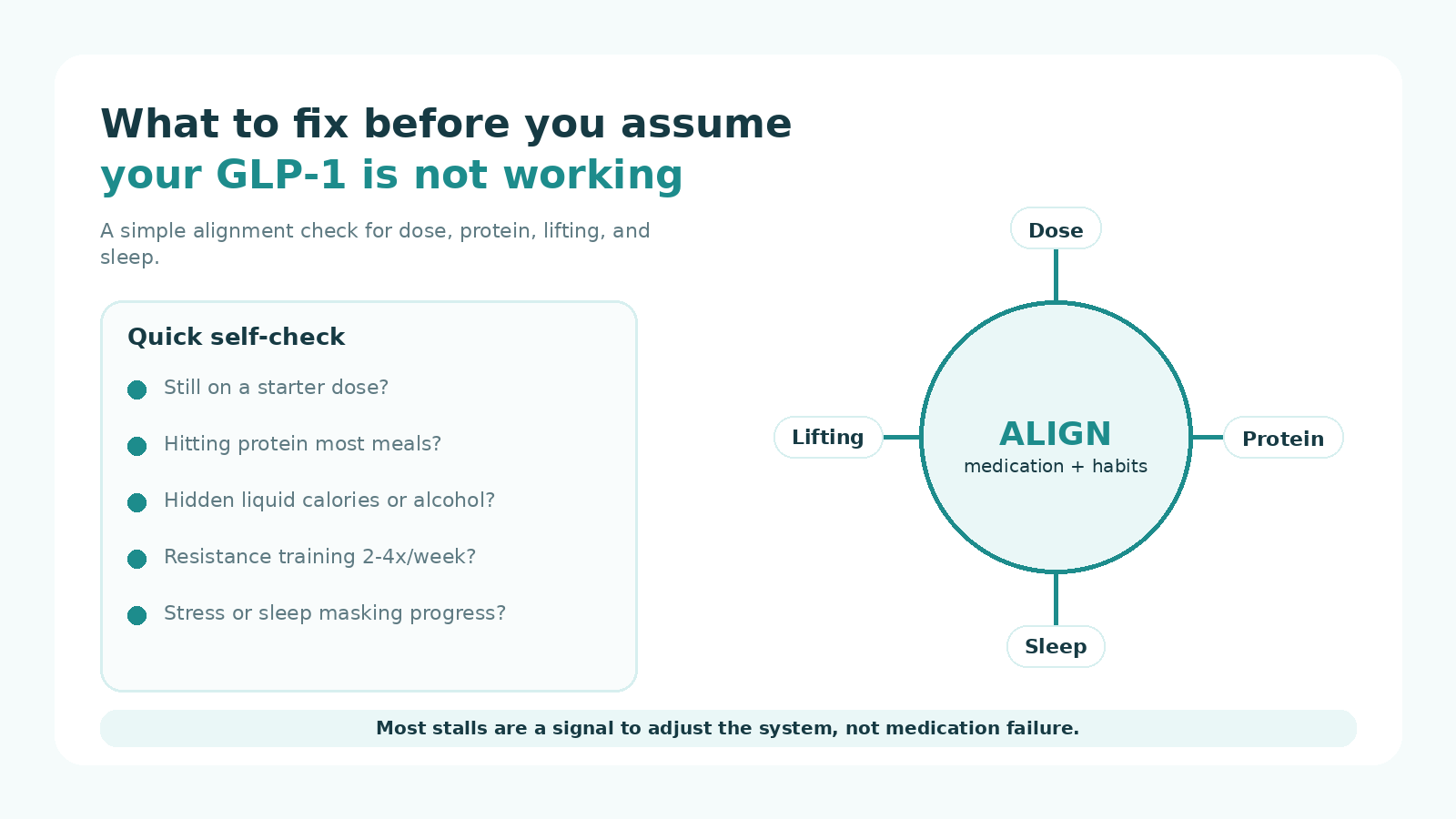
Try addressing these before you think the drug “isn’t working”.
What to do if you still aren’t losing weight?
If you have read the seven reasons above and thought, “Several of these are my problem,” don’t worry. In fact, most people who feel “stuck” on GLP-1 medications report a combination of reasons. Weight loss is rarely a straight line and GLP-1s will work only if the other lifestyle factors support, not oppose, their actions.
Stable sleep and low stress signal stable hormones. Restricting liquid calories and behaviour drift signals energy balance. When these signals are in harmony, weight loss resumes without medication changes.
Success on GLP-1s isn’t perfect. It’s about alignment. Once medication, food, exercise and stress are in harmony, progress often follows.
References:
Expected weight loss:
- STEP 1 semaglutide 2.4 mg trial New England Journal of Medicine
- SURMOUNT-1 tirzepatide obesity trial New England Journal of Medicine
Evidence linked to the 7 reasons:
- https://pubmed.ncbi.nlm.nih.gov/38937282/
- https://pmc.ncbi.nlm.nih.gov/articles/PMC8089287/
- https://pubmed.ncbi.nlm.nih.gov/20935667/
- https://www.cambridge.org/core/journals/british-journal-of-nutrition/article/does-adaptive-thermogenesis-occur-after-weight-loss-in-adults-a-systematic-review/726FC60518DA67349B9C3EC1D75A7156
- https://pubmed.ncbi.nlm.nih.gov/10878689/
- https://pmc.ncbi.nlm.nih.gov/articles/PMC4135489/
- https://www.wegovy.com/taking-wegovy/dosing-schedule.html
- https://pi.lilly.com/us/zepbound-uspi.pdf
- https://pubmed.ncbi.nlm.nih.gov/18640588/
- https://pubmed.ncbi.nlm.nih.gov/33667417/
- https://www.nejm.org/doi/full/10.1056/NEJMoa2107519
- https://www.ahajournals.org/doi/10.1161/CIRCULATIONAHA.124.067676?doi=10.1161%2FCIRCULATIONAHA.124.067676
- https://www.nature.com/articles/s41591-024-02996-7


GLP-1 Delivered
- Lose pounds of fat every week
- Weight Loss Money Back Guarantee
- No membership or hidden fees! Everything you need is included
- Start for just $179, no insurance required + free shipping


TRIMRX - GLP-1 DELIVERED
- 100% online medical review with licensed U.S. providers
- No insurance required
- Transparent pricing
- No hidden fee
Read this Next

Peptides for Weight Loss: Things to Know
Peptides are amongst the products from amino acids that build proteins in the body. Therapeutic peptides are developed to...

Do Weight Loss Patches Work?
Weight loss patches are designed for easy weight loss and promise that their active substances are absorbed by skin—transdermally....

Best Prescription Weight-Loss Pills?
The process of slimming appears to turn into a stressful event because there is a tendency to jump from...

Does Medicare Cover Wegovy, Zepbound, and Other Weight-Loss Medications?
Overweight and obesity are among the most important issues affecting health of population in the United States, especially of...