

In recent years, there has been a concerning surge in the weight loss industry, driven by a rise in health issues like diabetes, cardiovascular diseases, and cancer in developed economies. The shift in eating habits, sedentary lifestyles, and increased disposable income in North America and Western Europe have made individuals more prone to health problems. Consequently, there has been a notable uptick in the use of weight loss and weight management products.
U.S. Weight Loss Market: Dynamics
The weight loss industry is shaped by several factors that play a crucial role in its progress. Here are key insights into the current dynamics:
- Obesity on the Rise: Obesity is a major driver for the weight loss industry. Shockingly, in 2018, more than 42% of Americans were classified as obese, according to the Centers for Disease Control and Prevention (CDC). This surge has triggered a higher demand for weight loss products and services.
- Health Consciousness on the Upswing: Increasing health awareness has made individuals more mindful of their weight. People are actively taking steps to manage and maintain a healthy weight, leading to a surge in the demand for weight loss products and services.
- Market Size: The global weight loss market was valued at over $200 billion in 2022, indicating a substantial and growing industry.
- Online Presence: With the rise of digital platforms, the weight loss industry has seen a surge in online programs and apps. Online weight loss services are projected to continue growing due to their accessibility and convenience.
- Government Awareness Campaigns: Governments worldwide are actively raising awareness about the importance of maintaining a healthy weight. Initiatives, such as public health campaigns and school programs, contribute to increased consciousness about weight management.
- Technological Integration: Advancements in technology have led to the development of innovative weight loss solutions. Wearable devices, smart scales, and fitness trackers are becoming integral parts of weight management strategies.
- Diet Trends: The industry is responsive to changing dietary trends. Currently, there is a growing interest in plant-based diets, intermittent fasting, and personalized nutrition plans.
- Economic Impact: Economic factors, such as disposable income and employment rates, significantly influence the market. During economic downturns, consumers may cut back on non-essential spending, affecting purchases of weight loss products and services.
Report Scope of the Weight Loss Industry
| Features | Details |
| Market Size in 2023 | USD 159.69 Billion |
| Market Size in 2022 | USD 305.30 Billion |
| Market Size Projections in 2030 | USD 135.7 Billion |
| CAGR Growth Rate | 9.7% CAGR (2022-2030) |
| Base Year | 2022 |
| Forecast Period | 2023-2032 |
| Key Segment | By Product Type, Product Form, Nature, Category, End User Demography, Distribution Channel, and Region |
| Report Coverage | Revenue Estimation and Forecast, Company Profile, Competitive Landscape, Growth Factors and Recent Trends |
| Regional Scope | North America, Europe, Asia Pacific, Middle East & Africa, and South & Central America |
Market Size of the Weight Loss Industry
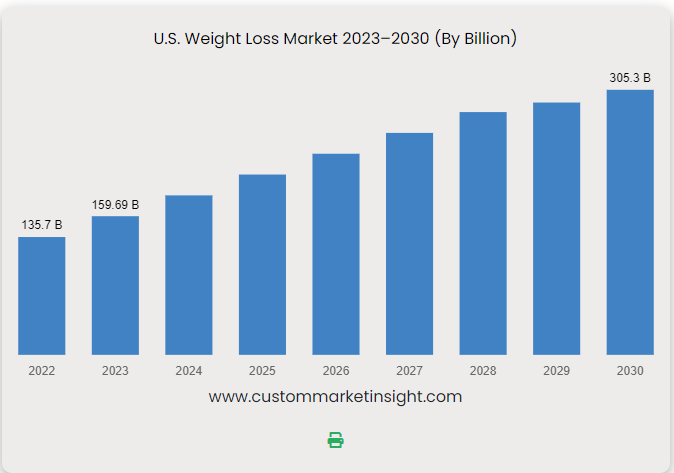
In 2022, the U.S. Weight Loss Market flexed its muscles, hitting a hefty USD 135.7 Billion. Fast forward to 2023, and it’s projected to pump up even more, aiming for USD 159.69 Billion. Brace yourself for the forecast – by 2030, it’s eyeing a heavyweight title at around USD 305.30 Billion. That’s a muscle-building compound annual growth rate (CAGR) of about 9.7% from 2023 to 2030. The weight loss industry is on a serious workout regimen, pushing for substantial gains in the coming years.
The U.S. Weight Loss Market – Regional Analysis
The U.S. weight loss industry reflects diverse trends across its regions, impacting the demand for weight management solutions.
1. Northeast Region: Battling High Obesity Rates
States: Maine, Vermont, Massachusetts, New Hampshire, New York, Rhode Island, Connecticut, Pennsylvania, New Jersey.
High obesity rates in New Jersey and Massachusetts are steering the demand for weight loss solutions.
2. Midwest Region: Bridging Gaps in Rural Health
States: Ohio, Michigan, Indiana, Illinois, Wisconsin, Minnesota, Iowa, Missouri, North Dakota, South Dakota, Nebraska, Kansas.
Large rural populations face limited access to fitness centers, but urban areas show a rising interest in healthier lifestyles.
3. South Region: Tackling Obesity Head-On
States: Virginia, Delaware, Maryland, West Virginia, Kentucky, Tennessee, Georgia, North Carolina, South Carolina, Florida, Alabama, Mississippi, Arkansas, Louisiana, Oklahoma, Texas.
All 16 states in this region surpass the national obesity average, intensifying the demand for weight loss solutions.
4. West Region: Prioritizing Fitness and Wellness
States: Montana, Wyoming, Colorado, New Mexico, Idaho, Utah, Nevada, Arizona, Washington, Oregon, California, Alaska.
Lower obesity rates and a focus on healthier lifestyles drive a significant demand for weight management solutions in this region.
Top 10 Prominent Players in the Weight Loss Industry
The weight loss industry is buzzing with activity and competition, as numerous companies strive to assist individuals in shedding those extra pounds. Standing out in this crowded market is crucial, pushing companies to present unique offerings that captivate and keep customers.
- Herbalife International Inc.
- Weight Watchers International Inc.
- NutriSystem Inc.
- Life Extension
- Brunswick Corp.
- Apollo Endosurgery Inc.
- Kellogg Company
- Ethicon US LLC: Ethicon Endo-surgery Inc.
- Atkins Nutritionals Inc
- Technogym
FAQs on Weight Loss Industry
1. Who’s the target market for weight loss products?
Weight loss products are crafted for individuals seeking better body composition. This includes those wanting to shed pounds, cut body fat, or boost overall health. Typically, adults between 20-50 years old are the prime focus. They’re driven by a desire for improved health, aesthetics, or addressing weight-related health issues.
2. Why does the diet industry thrive?
The diet industry flourishes because many are eager for quick fixes. The desperation to shed weight sometimes overshadows the realistic, gradual approaches. Quick fixes often promise instant results, tapping into the desire for rapid transformations.
3. Does location matter in weight reduction?
In the world of weight reduction, location plays a crucial role. Considering the general rule that transportation costs rise with weight, “bulk-reducing industries” tend to set up close to raw material sources. On the other hand, “bulk-gaining industries” prefer proximity to large markets, aligning with their need for convenient access.